Astronomy and Astrology: A Faculty Panel Discussion

Close up of Stein Manuscript Dunhuang Star Chart

Astronomy and Astrology today suggest to us two different things: The scientific and the esoteric. In other times and cultures, the boundaries were not so distinct. Join several experts in the history of astronomy as they discuss these concepts from past to present.

Panel Members

  • Michelle McCoy, Department of History of Art and Architecture
  • Jeffrey Kotyk, visiting scholar, Max Planck Institute for the History of Science
  • Sandhya Rao, Department of Astronomy

Moderator

  • Jason Rampelt, University Library System

This event is co-sponsored by the Department of Classics: the Classics, Philosophy, and Ancient Science Program, and the ULS.


Event Date
Wednesday, April 8, 2026
Event Time
2:30 - 3:45 p.m.

The Size of the Universe

A talk by Carlos Badenes, Department of Physics & Astronomy

A talk by Carlos Badenes, Department of Physics & Astronomy

We all know the Universe is big - but how big is it, exactly? Human beings have spent thousands of years trying to figure this out, but we only arrived at a reasonably accurate measurement a little over two decades ago. Carlos Badenes will take you on a historical journey from the first attempts to measure the size of our planet by the ancient Greeks to our most accurate current estimates for the size of the observable Universe. Along the way, we will meet the characters involved in the key advances and describe the methods they used to make their measurements.

Event Date
Monday, April 6, 2026
Event Time
2:30 - 3:45 p.m.

From Galileo’s Starry Messenger to Cosmic Poetry: Early Modern Perspectives on the Universe Poster Presentation

People at Poster Session

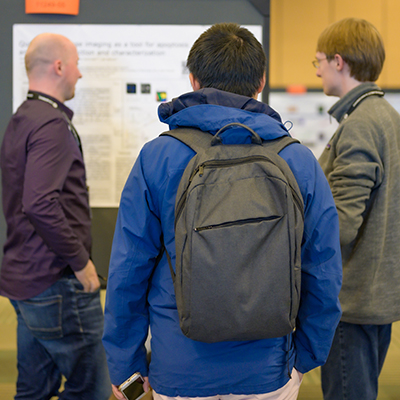
In this interactive poster session, Pitt students present their research on early modern views of the universe, including the momentous shift from geocentric to heliocentric views of the cosmos in the seventeenth century. Exploring topics that range from the work of Galileo and other seventeenth-century astronomers to the imaginative responses of poets like Margaret Cavendish and John Milton, these projects investigate how early modern scientists, artists, and poets embraced or resisted these earth-shattering changes: What it was like for people as they came to see their place in the cosmos in an entirely new way?

After the poster session, the posters will be on display at Bevier Science and Engineering Library for the remainder of the semester. 

Event Date
Thursday, April 9, 2026
Event Time
2:30 - 3:45 p.m.

Visualization of the Heavens: Digital Tools for Understanding Historical Astronomy

Jeffrey Kotyk, Max Planck Institute for the History of Science

A talk by visiting scholar Jeffrey Kotyk, Max Planck Institute for the History of Science

Visualization of the Heavens is a digital database developed by the Max Planck Institute for the History of Science in Berlin. Containing close to 10,000 objects with metadata and tags, it allows users to collate objects related to stars, astronomy, cosmology, and related religious concepts from diverse pre-1700 Eurasian cultures. This lecture given by visiting scholar Jeffrey Kotyk will showcase the database while showing some practical applications for the purposes of comparative research while also underscoring the potential educational use of the platform in the university classroom. 

This event is co-sponsored by the Classics, Philosophy, and Ancient Science Program, the Department of Classics, and the ULS.

Event Date
Friday, April 10, 2026
Event Time
2:30 - 3:45 p.m.

Galileo and the Tides as Proof of the Copernican System

Paolo Palmieri (Dept. of History and Philosophy of Science)

A talk by Paolo Palmieri, Department of History and Philosophy of Science

Behold the grand, glittering blunder of Galileo Galilei! In a stroke of audacious theater, he aimed to use the rhythmic heaving of the oceans as the ultimate proof that the Earth whirls around the Sun. His proof crumbled—the Moon, not the Earth's spin, is the true solution. Yet while he lost the battle for the Copernican system, but he won the war for the waves, shattering the ancient idea of a static universe in the process!

Event Date
Wednesday, April 8, 2026
Event Time
11 a.m. - 12:30 p.m.

Visions of Vision: Comets and the Origins of the Observatoire

visiting scholar Claire Goldstein, University of California, Davis

A talk by visiting scholar Claire Goldstein, University of California, Davis

Claire Goldstein will present the story of how astronomical controversy over a comet's path led to the establishment in 1666 of the French Royal Academy of Sciences and the construction of the Royal Observatory, and will discuss how images of the Observatoire played an important role in signaling the French commitment to observation. Goldstein's recent book, In the Sun King’s Cosmos: Comets and the Cultural Imagination of Seventeenth-Century France, takes as a point of departure two unusually bright comets that galvanised public attention in 1664-65 and 1680-81, bookending the period during which Louis XIV’s sun king mythology was created.

This event is sponsored by the Medieval and Renaissance Studies Program.

Event Date
Tuesday, April 7, 2026
Event Time
2:30 - 3:45 p.m.

From Stonehenge to Hubble Poster Presentation

Students looking at a poster presentations

Students in Astronomy 0088, "From Stonehenge to Hubble" (Dr. Sandhya Rao) have worked with Open Lab to construct astronomical instruments from ancient cultures around the world. Come see an armillary sphere, astrolabes, and models of monuments from India to Mexico used for telling time. They will demonstrate how they work and answer your questions.

Event Date
Monday, April 6, 2026
Event Time
10 a.m. - 1 p.m.

Astral Knowledge in Ancient Greece

Headshot of Stamatina Mastorakou

A talk by Stamatina Mastorakou, Department of Classics

People have long been fascinated by the heavens, striving to comprehend the movements of celestial bodies and the mysteries of the cosmos. Across cultures and throughout history, this curiosity has shaped intellectual life, influencing the creation of calendars, navigation systems, and our understanding of seasonal and astronomical cycles. In this lecture, we will explore key concepts of ancient Greek astronomy and examine how the sky was envisioned and represented. We will consider the major cosmological models that arose in the Classical and Hellenistic periods, and explore how celestial phenomena impacted daily life—from agriculture and weather forecasting to healing practices and ritual traditions—leaving their imprint on texts, inscriptions, and material culture.

Event Date
Friday, April 10, 2026
Event Time
11 a.m. – 12:30 p.m.